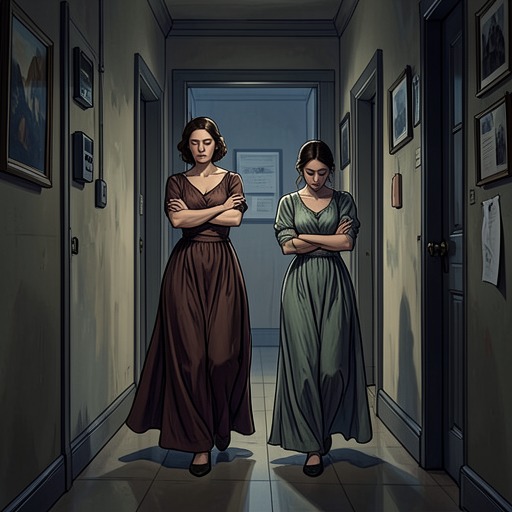
Nina
The Lost DaughterNina is Elena’s mother, a young woman whose life in the summer beach community is presented through the watching, sometimes mistaken perspective of Leda. Her first appearance suggests an ease with her daughter that later scenes complicate: she can attend to Elena with tenderness, yet becomes overwhelmed by the demands around her. Her conflict with Leda over the doll ends their uneasy intimacy in a rupture that joins a concealed history, a deliberate departure, and a sudden act of violence.
Identity and Introduction
Leda first notices Nina returning from the water with Elena, then about three or four years old. Nina is described as no more than twenty. The two walk toward their umbrella talking peacefully, seemingly absorbed in one another; Elena holds her doll as a mother might carry a child. Nearby, an older woman makes disapproving gestures, while a pregnant woman calls irritably toward them. Nina appears not to respond, continuing up the sand with Elena. The scene establishes a close mother-daughter pair within a larger, watchful family setting, but it is Leda’s limited view: she can observe Nina’s gestures without yet knowing who the other people are or what has provoked their reactions.
Leda initially cannot tell whether the mother or daughter is called Nina, among the many forms of the name she hears, including Ninù and Ninè. By listening to the family, she works out that Nina is the mother. She is also briefly confused by the names Nani, Nena, and Nennella, which she takes to be Elena’s possible nicknames. They are names for the doll instead. Elena is called Elena by Nina and Lenù by relatives; the child remains closely attached to the doll, and Nina treats it with an attention that makes it seem like another daughter. Nina’s care for the doll therefore belongs to the family’s everyday life before it becomes the focus of her conflict with Leda.
Motherhood and Family Strain
Nina’s public composure gives way when Elena goes missing. As family members call the child’s names, Rosaria walks quickly toward the sea. Nina touches her forehead and turns first one way, then abruptly back the other. Leda describes her face and eyes as altered by anxiety. Nina cannot find Elena and has lost sight of her; the episode makes the intensity of her fear visible in movement rather than explanation. It also contrasts with the earlier image of mother and daughter walking together, showing how quickly their apparent calm can be broken by the practical uncertainty of caring for a child.
At sunset, Elena cries because she wants to return to the water, and Rosaria offers to take her. Nina loses her composure and shouts at her sister-in-law in a harsh dialect, drawing attention from across the beach. Rosaria falls silent. Tonino, Nina’s husband, interrupts and leads Nina toward the shore by the arm. Leda observes that he maintains an outwardly controlled manner even when his actions become forceful. He speaks to Nina, but Leda cannot hear him; Nina looks down, touches her eyes, and occasionally says no. The scene gives no account of what Tonino tells her, leaving the reader with Nina’s visible distress and the contrast between her angry outburst and his controlled intervention.
Marriage, Desire, and Private Escape
Gino watches Nina from a distance while pretending to study. When the beach becomes crowded, he sets aside his textbook and uses binoculars to follow the family. Leda imagines what he may be thinking about Nina’s married life, but this is explicitly her speculation, not access to Gino’s knowledge or Nina’s private thoughts. Later, Gino greets Nina, Rosaria, and Tonino with conspicuous deference. He awkwardly tries to pet Elena, who is in Nina’s arms eating cotton candy, then remains beside the family, stiff and silent. Nina hands Elena to Rosaria and makes Tonino dance. Leda notices that Nina moves with a natural harmony even beside her ungainly husband, while Gino watches her and asks Leda to dance. These observations place Nina between the formal presence of her husband and Gino’s attention, without making her feelings fully legible.
Gino later conveys that Nina wants to borrow Leda’s apartment for a few hours. Nina comes to Leda’s door at five, still in her bathing suit, with wet hair and a new hat. She has left Elena with Rosaria, saying she needs to get nose drops for the child’s stuffy nose. Leda can see that Nina is agitated. Nina says she cannot take the situation any longer, but the available account does not explain every pressure behind that statement. The request and the excuse establish a planned private departure from the family’s immediate supervision; together with Gino’s message, they point to a meeting Nina is trying to arrange with him. Her wish for time away sits beside her continuing responsibilities to Elena, whom she has entrusted to Rosaria.
Relationship with Leda and the Doll
Nina’s connection with Leda changes from wary proximity to a personal confrontation. At one point Nina asks why Leda left her daughters. The question places Leda’s past separation directly into their relationship: Nina is not only a mother being observed by Leda but also someone who challenges Leda about motherhood. Later, Nina tells Leda that Leda had Elena’s doll and kept it while Nina did not know what to do. Nina recalls her daughter crying and driving her to distraction, and accuses Leda of seeing their distress without intervening or saying anything. Her grievance concerns both the concealed doll and Leda’s failure, as Nina understands it, to help when she was overwhelmed.
In the final confrontation, Nina leaves without taking the keys or her hat, but takes the doll. Before leaving, she uses the Hatpin to stab Leda. The account presents the attack as sudden and brief, without resolving all the anger behind it. Nina’s departure with the doll is nevertheless decisive: an object previously treated as Elena’s companion and as a second daughter in Nina’s attentions becomes the concrete point of separation between the women. The doll’s return to Nina and Elena is inseparable from the break with Leda.
Narrative Role and Significance
Nina is introduced through external observation, and that framing continues to limit what can be said with certainty about her motives. Leda sees Nina’s quiet walk with Elena, her panic when the child is lost, her public quarrel with Rosaria, her dancing, and her agitation at the apartment door. She also imagines Gino’s thoughts and cannot hear Tonino’s words. Nina’s own accusations eventually correct the observer’s distance, but they do not turn her into a fully explained figure: her distress is concrete, while its causes remain only partly disclosed.
The changing role of Elena’s doll gathers the tensions surrounding Nina. At first, it is an everyday object to which Elena is devoted and which Nina treats as though it belonged to another child. Later, its concealment becomes part of Leda’s withheld history, and Nina’s account links it to a time when she felt unable to manage her crying daughter. Nina’s final recovery of the doll does not resolve the strained relationships among mother, child, and observer; it gives those strains an unmistakable consequence. Her character is shaped by the coexistence of attentive care, visible exhaustion, a wish to escape immediate constraints, and anger directed at the person who watched without, in Nina’s view, helping.